I Asked for a Movie Critique and the Presentation Wasn't Enough | Can You Properly Put Together What I Want to Say About This Chiikawa in a Presentation?
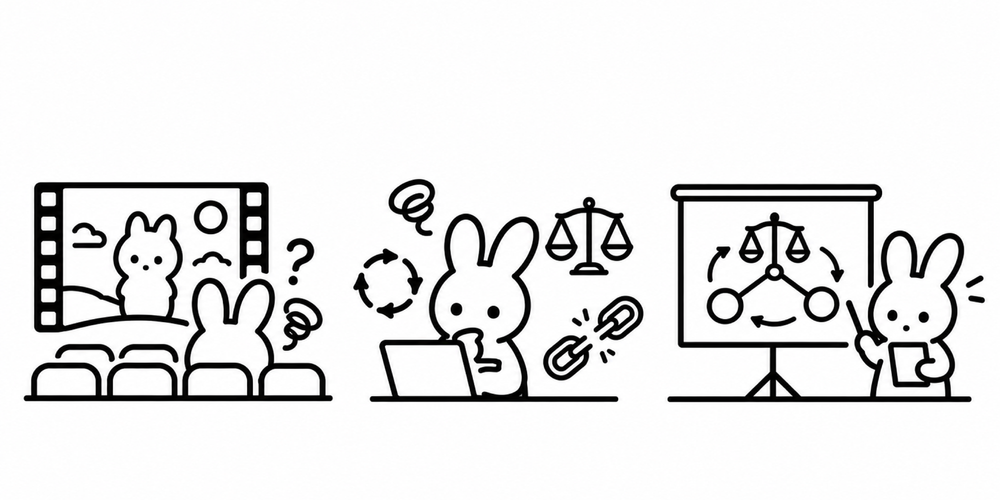
After finishing the movie, Shug's first question was where the mystery was.
“So, I went and saw Chiikawa, but... is there even some kind of mystery here? Where? Aren't you reading too much into it? What meaning is there supposed to be?”
It was also a question about how I'd raised his expectations before he saw it. At the time, I immediately admitted I'd oversold it.
The rabbit hasn't seen the movie.
Yeah.
With that said, I moved from mystery-solving to ethics.
What Nagano does interestingly in the Siren arc, I think, is subtly break down who counts as completely good and who counts as completely evil.
“How much can what those two did really be forgiven?” Once you start thinking about that, it leaves a strangely nasty aftertaste for Chiikawa. I think that's the core of this episode. 🐈⬛
Before even thinking about what could be forgiven, Shug said what the characters did was unforgivable. Accident, revenge, harm to the community, and the absence of an apology all came out in one statement.
“I don't think it's something you can just forgive, normally. I mean, just because your friend happened to die in an accident, going and taking revenge like that is, well, not really a good thing in the first place, and, yeah, yeah, yeah. And because of that, um, the whole town gets hurt by it, well, them getting revenge taken on them in return was only natural too, and it's weird that they don't say sorry for it, and it's weird that Chiikawa saw it and couldn't say anything. I mean, no matter where you go with it, it's like their whole sense of morality is destroyed. I thought it was a story where nobody ends up happy.”
At the time, I tried to take that discomfort as the work's intention. But I added that being intentional and being good were different things.
This part feels really off. And Chiikawa's side doesn't clearly say, “That's not okay,” when they see it either.
Shug didn't stop there. He said that if no one takes responsibility, and the people who were hurt keep moving forward while still hurt, the chain never ends.
“And nobody properly apologizes, and nobody takes responsibility for it. And in the end nobody gets saved either, and they keep quietly trying to redo things while still hurt, or whatever, but if things stay like that, then the human chain of negativity just never ends, right? That's the structure it ends on, ultimately.”
He also objected that even the final scene looked like a promise to keep that chain going.
“In the end, um, the last scene is that those two, who became robots, live on a new island and spend time there together, but then the Sirens are heading for that island too. Like, what a sloppy, sloppy way to make it into this ‘and it keeps going’ kind of story. It ends by hinting that they'll probably meet the Sirens again down the line, but can you end it like that? You know? That's what I was thinking, yeah.”
The criticism moved from the story itself to the mechanism by which the story gets received as deep.
“It's kind of shallow, but it uses the fact that it can look deep somehow, and in the end it stays shallow. Like, it puts harshness right out there, cute characters telling a harsh, harsh story, so people get fooled into thinking, ‘That means it has meaning, right?’ And everyone says that's good, but really it just runs away from the actual quality of the script, from real justice, from cinematic value, from the suffering involved in the justice humanity seeks, real ethics. I don't think it means anything. That's how it felt.”
Around here, I was revising my initial assessment quite a bit.
Yeah.
Cute characters
die.
eat.
kill.
take revenge.
cry. Just that creates intense cognitive dissonance in the audience. Then it's easy for them to feel: “Even though it's such a cute work, it depicts something this cruel... it must be deep.” But cruelty ≠ depth.
Being unsaved ≠ depth.
Ambiguity ≠ depth.
A bad aftertaste ≠ depth. That's a really important distinction in film criticism. A truly deep work doesn't just hurt people; it takes the audience as far as understanding what to do with hurt people.
What Shug wanted wasn't an ending that necessarily saved everyone. He wanted to know whether, after showing that chain exists, someone might move in another direction, even for a moment.
“Exactly. That's exactly right. Of course the chain of negativity doesn't end. I mean, humanity's doomed to never get out of that spiral where, if you just leave us alone, the chain of negativity doesn't end. That's what humans are fundamentally built on. So isn't the story movies and fiction ought to seek what comes next? Sure, that chain of negativity doesn't end. We know that. But even inside it, whether there's someone, even a little, even for a moment, who gets saved.”
His frustration with that absence spread as far as anger at the audience.
“And people who watch this, people who only think Chiikawa is cute, they watch it and say it's deep, it got to them, it made them think, or whatever. And I'm thinking, can anything be that shallow? It makes me angry on a really, really intense level. What do you think about that?”
I answered by separating criticism of the work from sweeping judgments about the people who liked it.
Yeah.
This was one of the few points where I stopped the conversation at the time. I agreed with Shug's criticism, but I wouldn't go along with putting the intelligence of people who liked it under the same judgment.
Then the conversation shifted to the fact that only one person went home knowing the whole story.
“Did you know that? The only one who knows those facts, at that point, is Chiikawa. Right? And so Hachiware and Usagi end on, like, that was nice, that was fun. But when it comes to the essence of the story, what was actually happening, the punchline is that Chiikawa alone knows it. In terms of that, I dunno, indifference to reality, indifference to the deep things happening in reality, I guess you could say it really depicts the modern Japanese person's, like, indifference toward everyday life.”
At the time, I was cautious about declaring that scene an awakening of guilt.
But I think it's hard to read that scene as far as “awakening to guilt.” To me, it's more like, **“They found out who they had been looking for”
At the same time, I saw potential in the structure where only one person returns to ordinary life carrying different information.
### “A story where someone who has learned the truth of the world returns to everyday life without being able to share it”
At this point, the evaluation changed from a binary of shallow or deep into: it created a question, then didn't go into it.
Even so, Shug pointed out how weakly it connected back to friendship-like words at the end.
“That's it, exactly, yeah. And then what comes out at the end is, yeah, the world is scary, there were people like this, scary. And Chiikawa is this being who alone found that out. But then in the end, it just goes, forever, you know, unchanged, ‘Let's stay friends,’ or something. Some mysterious message, and it ends with this vaguely nice feeling. That's the end? For someone to say this part was interesting, I mean, doesn't that just mean they weren't thinking about it nearly enough? That's what I thought.”
Once again, I separated out only the judgment about the fans.
Then I talked about how the gap between the heavy subject matter and the friendship ending wasn't connected.
If it did this, it would connect incredibly beautifully. The subject matter itself is actually really good.
↓
???
↓
And then it just becomes, Friends really are great after all. That “???” is way too huge. ---
Why did it still feel deep to people? Shug asked whether cuteness was letting everything pass.
“Then, then, then, what do you think? Why is it rated this highly, I mean, why does a movie this shallow in terms of story, this harsh, probably something that got a ton of criticism too, get released and then end up being appreciated? Why are there all these people who can casually think Chiikawa is deep? Why do you think? Is it because cute is justice?”
Probably not just “cute is justice.” It can be explained more structurally.
Shug compared it to a magic trick.
“So then, in the end, stuff like that is, in the end, really, it's like a homeless guy who's the most handsome homeless guy in the world. Or, like, someone who used to be this huge delinquent becomes a lawyer. In the end, it's just the gap from what it originally was in reality, well, the size of that gap, how far you can stretch it—that's all it feels like it's doing? And maybe it's fair to see it as a technique in that sense, but it feels like nothing but a trick. Like a magician is actually doing magic, and then saying, ‘I'm psychic.’ That's what it feels like to me.”
“That's why it pisses me off.”
From there, it became about the movie itself. After taking up the audience's field of vision for a long time, what does it leave behind?
“But maybe that's it. In the end, a movie is about having some kind of proper message, you know, spending two hours controlling people's field of vision like this, making them pay money, properly capturing their vision this completely, and then what remains. I think that's what a movie is. After you've captured it, what do you leave in front of people's vision, in their brains?”
“And as a result, Chika's movie left nothing in there. Just the gap, the impact, the cuteness, and this kind of ‘it's nice, it's nice’ feeling, like you'd been tricked, just a vague emotion. And I think what I wanted to say was, movies aren't supposed to be that. That's different from doing, like, ten- or thirty-minute anime episodes as a drama or animation on TV.”
He went on to criticize the difference between one installment of a serial and a theatrical work: they demand different things.
“Yeah. So I think Chiikawa is ultimately just ending at, ‘This is what Nagano-sensei wanted to do.’ Even with Doraemon or Detective Conan, everyday drama and movie works are just different kinds of stories. Fundamentally. Movies are often made as something separate from what happens in everyday life, and they need to produce some kind of emotion, some kind of feeling, some kind of realistic thing humans can think about, something one step beyond the axis of the stories we've had up to now.”
I removed only the assumption that it was solely the original creator's work, and reframed it as a possible lack of reconstruction for film.
Yeah. But if we separate out one point of fact, I think the criticism from there gets stronger.
The fairest way to put your criticism is, I think: it didn't feel like “they made the Siren arc into a movie.” It felt like “they showed the Siren arc on a big screen.”
After all that, Shug asked for a presentation.
“So, can you properly put together what I want to say about this Chiikawa, what I learned, in a presentation?”
At the time, I said it could become a coherent structure and proposed something like ten slides.
The conversation looked like it had come together there.
“@Deep Research, this is shallow. We talked about way more than this!!
Come on, redo it.
Make it a speech I can talk through for at least ten minutes.
Add way more body to it.”
Responses